

Mastering the 28-Day Rule: Bank Statement For Study Visa Pakistan
Dreaming of packing your bags for a world-class degree in the UK? You’ve got your university offer, your IELTS score is sorted, and you’re ready to fly. But then comes the biggest hurdle that trips up thousands of Pakistani students every single year: the dreaded financial proof.
When it comes to securing your international future, nothing is more critical than preparing a flawless bank statement for study visa Pakistan applications. The UK Visas and Immigration (UKVI) department does not take chances with finances. If your financial paperwork has even a minor glitch, it results in an automatic visa refusal—no questions asked.
Let’s break down the strict rules of the “28-Day Rule,” how to legally prove your income, and how to avoid the hidden traps that catch students off guard.
What Exactly is the 28-Day Rule?
The core financial requirement for a UK student visa states that you must prove you have enough money to cover your first year’s tuition fees plus your monthly living expenses (maintenance funds). For courses in London, you need £1,529 per month (up to 9 months), and for universities outside London, you need £1,171 per month (up to 9 months).
But here is the catch: you can’t just borrow money, deposit it into your account overnight, and print out a statement.
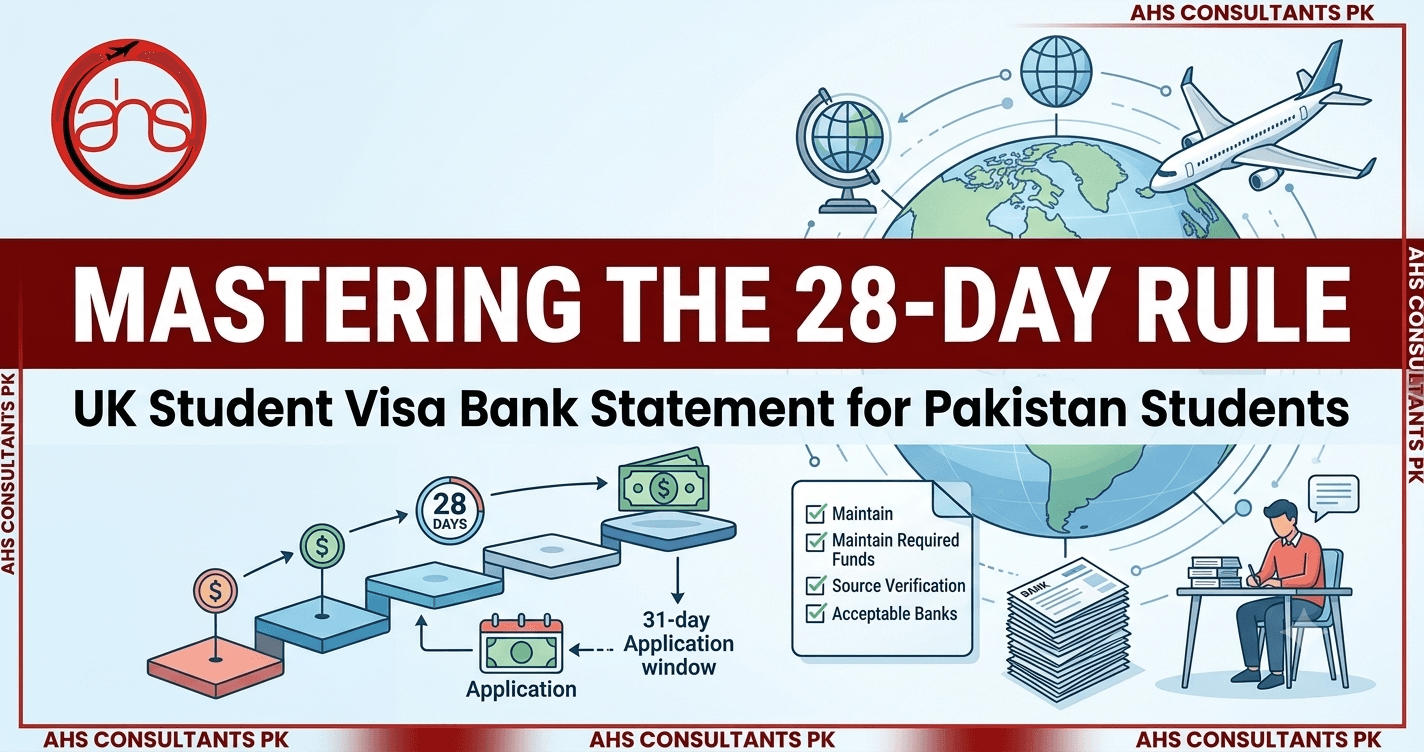
The UKVI requires that your total required funds for UK student visa from Pakistan must sit untouched in an approved bank account for at least 28 consecutive days.
The Golden Rule: If your balance drops even a single rupee below the required threshold on Day 22, the 28-day clock resets back to zero. Even if it goes back up the next day, an application submitted with that statement will face immediate rejection.
Furthermore, your official bank letter or statement must be dated within 31 days of the exact date you submit and pay for your online visa application. Timing is absolutely everything.
How to Show Source of Funds for Visa Applications Legally
With financial scrutiny at an all-time high, visa officers don’t just want to see a final number; they closely look at transaction histories. If a massive, unexplained lump-sum deposit suddenly appears in your account right before the 28-day cycle begins, it flags a massive warning.
Knowing how to show the source of funds for visa compliance means linking that money back to a legitimate, verifiable origin. Valid sources include:
Salaried Income: Regular monthly salary transfers matching your or your parents’ employment contracts and payslips.
Business Profits: Verifiable business bank accounts, tax returns (FBR certificates), and company registration documents.
Property Sales: Legal sale deeds of land or property, showing the funds moving directly from the buyer into your bank account.
Agriculture Income: Official documents detailing crop sales or land revenue are common across agricultural sectors in Pakistan.
If you are using your parents’ accounts as your financial backing, remember that you must provide your official birth certificate, a signed parent consent letter confirming they are funding your education, and their CNIC copies. Business accounts, even if the business belongs entirely to your parents, are strictly forbidden by UKVI unless the funds are formally transferred into a personal account.
Keep Your Eyes on Acceptable Banks for Visa in Pakistan
You cannot use just any cooperative society or local committee fund to show your balance. The UKVI maintains a clear framework regarding which financial institutions it can reliably verify.
The most widely accepted banks for Visa in Pakistan include leading commercial entities with robust digital record-keeping systems, such as:
Habib Bank Limited (HBL)
United Bank Limited (UBL)
Meezan Bank
MCB Bank Limited
Bank Alfalah
Standard Chartered Bank (Pakistan)
Using unapproved, non-regulated institutions or attempting to show wealth via gold, cryptocurrency, stocks, or locked pension funds will lead directly to a visa denial.
Don’t Navigate the Hurdle Alone
The financial aspect of your visa application leaves zero margin for error. Currency fluctuations between the British Pound (£) and the Pakistani Rupee (PKR) mean you always need to maintain a healthy financial buffer in your account to stay safe.
Before you print your final statement and hit submit, having an expert double-check your dates, source documents, and bank letters can save you a year of heartbreak. The experienced team at AHS Consultants PK specialises in assessing financial documentation to ensure it complies completely with updated UKVI guidelines. From calculating exact maintenance thresholds to formatting ironclad parent sponsorship letters, professional guidance turns a stressful hurdle into a smooth transition.
Keep your funds stable, double-check your bank’s digital credentials, and plan your timeline early to ensure your academic journey starts exactly on schedule!

Leave A Comment