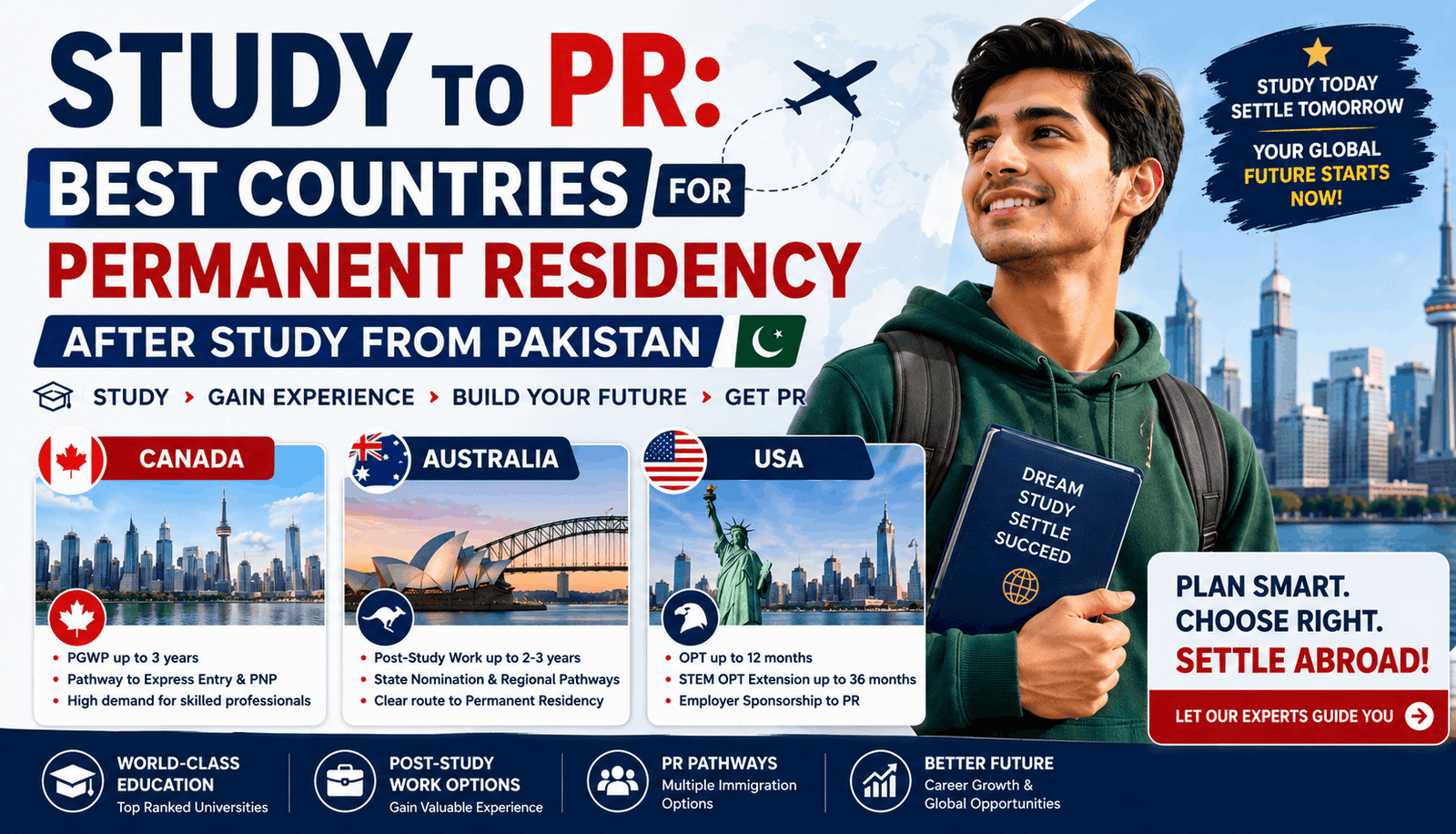
For many Pakistani students, studying abroad is about more than earning an international degree. The bigger question is often: “What happens after I graduate?”
If your long-term goal is to build a career overseas and eventually qualify for permanent residency, choosing a university and course requires more thought than simply comparing tuition fees or rankings.
The immigration rules in Canada, Australia and the USA are different, and none of these countries guarantees permanent residency simply because you studied there. Your qualification, occupation, work experience, language ability, age, employer, points or immigration category can all influence your options.
That is why the best country for you may not necessarily be the country with the longest post-study work visa. The better choice is the country where your education, career plans, and potential immigration pathway work together.
In this guide, we compare Canada, Australia and the USA and explain what Pakistani students should realistically consider when planning a study-to-PR pathway in 2026.
What Does “Study to PR” Actually Mean?
A study-to-PR pathway is not usually a single visa that automatically changes from student status to permanent residence. Instead, it is a series of steps that may look something like this:
Study → Graduate → Post-study work → Gain relevant experience → Qualify for an immigration pathway → Apply for permanent residence
The exact process depends on the country.
For example, a Canadian graduate may use Canadian work experience and potentially qualify for Express Entry or a Provincial Nominee Program. An Australian graduate may work toward a skilled or employer-sponsored pathway, while a U.S. graduate may use OPT/STEM OPT to gain experience before pursuing an employer-sponsored immigration route.
So, when comparing countries, you should look at the entire journey, not just the student visa.
1. Canada – A Strong Study-to-PR Option, But Competition Matters
Canada has traditionally been one of the most popular destinations for Pakistani students who want to study, gain Canadian work experience and eventually pursue permanent residency.
However, Canada’s international student and temporary resident policies have changed significantly. Students should therefore choose their programme carefully rather than assuming that every Canadian qualification provides the same immigration opportunities.
Canada Post-Graduation Work Permit in 2026
The Post-Graduation Work Permit (PGWP) allows eligible graduates from participating Canadian institutions to gain Canadian work experience after completing their studies.
Current rules require most applicants to provide proof of English or French language ability when applying for a PGWP.
For graduates with a bachelor’s, master’s, or doctoral degree, the current requirement is generally CLB 7 in English or NCLC 7 in French in all four language abilities. These degree graduates do not have a field-of-study requirement.
This makes university-level programmes particularly important for students who are considering Canada as part of a longer-term immigration strategy.
Why a Master's Degree Can Be Strategic
Canada currently allows eligible graduates of master’s programmes to receive a 3-year PGWP even when the master’s programme itself is less than two years, provided the other eligibility requirements are met.
That additional work period can be valuable because it gives graduates more time to:
- Build Canadian work experience
- Improve their language scores
- Develop their professional profile
- Explore Express Entry
- Consider provincial nomination opportunities
- Find an employer willing to support a longer-term immigration strategy
However, a 3-year PGWP does not mean automatic PR.
Canada's Express Entry and PNP Routes
Canadian graduates may potentially qualify for permanent residence through programmes such as the Canadian Experience Class, depending on their circumstances and work experience.
IRCC confirms that Canadian graduates can potentially qualify for the Canadian Experience Class after obtaining the required skilled Canadian work experience and meeting the relevant language requirements.
Another important option is the Provincial Nominee Program (PNP).
Provinces and territories have their own immigration streams designed around their labour-market and demographic needs. If you receive an eligible provincial nomination through Express Entry, the nomination can provide 600 additional CRS points, which can significantly improve your chances of receiving an invitation to apply for permanent residence.
Who Should Consider Canada?
Canada can be particularly attractive if you:
- Want to complete a bachelor’s or master’s degree
- Are prepared to build a career in Canada after graduation
- Can meet the required English or French language standards
- Have a realistic plan for gaining skilled Canadian work experience
- Are willing to consider provinces outside the most competitive locations
Important: Don’t choose a Canadian course simply because it is cheap. Check the institution, programme eligibility, PGWP rules, and your potential career pathway before paying a deposit.
2. Australia – Strong Skilled Migration Opportunities for the Right Graduate
Australia remains another major destination for Pakistani students who want an international education followed by a possible long-term migration pathway.
But just like Canada, there is no automatic conversion from a student visa to permanent residency.
Your occupation, skills assessment, English ability, age, points, state nomination, and employment situation can all matter.
Australia's Post-Study Work Option
The Temporary Graduate visa (subclass 485) Post-Higher Education Work stream allows eligible international graduates to temporarily live, work and study in Australia after completing an eligible Australian degree.
Under the current rules, the stay period is generally:
- Bachelor’s degree – 2 years
- Master’s coursework/extended – 2 years
- Master’s research – 3 years
- Doctoral degree – 3 years
These rules can change, so students should always check the current Department of Home Affairs requirements before choosing a programme
Why Regional Australia Can Be Worth Considering
One of the most important concepts for students considering Australia is regional study and migration.
Australia has state and territory nominated pathways, including:
- Subclass 190 – Skilled Nominated
- Subclass 491 – Skilled Work Regional (Provisional)
States and territories assess applicants according to their own requirements and workforce priorities.
However, students should not assume that every applicant will automatically receive a scholarship.
Eligibility, income documentation, academic requirements and the specific scholarship scheme all matter. The Italian government also notes that some universities provide exemptions from enrolment and university fees under applicable rules.
The subclass 491 points framework provides 15 points for eligible state or territory nomination or eligible family sponsorship.
The subclass 491 pathway can eventually lead toward permanent residence through subclass 191 if the relevant eligibility requirements are met. The Department of Home Affairs states that eligible holders must generally hold the qualifying visa for at least three years and meet the applicable income and other requirements.
Australia's 2026 Migration Landscape
Australia’s permanent Migration Program for 2026–27 is set at 185,000 places, including 132,240 places in the Skilled stream. The government has also stated that it will prioritise many applicants already living in Australia.
This does not mean that every international graduate will receive PR. Instead, it reinforces the importance of choosing a career and location that align with Australia’s skilled migration needs.
Who Should Consider Australia?
Australia may be worth considering if you:
- Want to study in a strong English-speaking economy
- Have a career in a skilled occupation
- Can achieve a strong English score
- Are willing to consider regional areas
- Can build relevant Australian work experience
- Are prepared to compete for state nomination or another skilled pathway
Important: Don’t select a course only because a consultant says it is “good for PR.” Your occupation, skills assessment, and future eligibility need to be checked against the actual migration rules.
3. USA – Excellent Career Opportunities, But PR Is Less Direct
The United States is different from Canada and Australia. There is no simple points-based “study-to-PR” system for international students.
However, the USA remains extremely attractive for Pakistani students because of its universities, research opportunities, technology sector, healthcare industry and large professional job market.
For the right graduate, the U.S. can provide a strong platform for building the experience needed for a longer-term employment-based immigration strategy.
Understanding OPT After Graduation
Eligible F-1 students can generally receive up to 12 months of post-completion Optional Practical Training (OPT).
Graduates with qualifying STEM degrees may be eligible for an additional 24-month STEM OPT extension, potentially providing up to 36 months of post-completion practical training in total.
This extended period can be particularly valuable for graduates pursuing careers in areas such as:
- Computer Science
- Data Science
- Engineering
- Information Technology
- Mathematics
- Certain scientific disciplines
STEM OPT Has Strict Requirements
STEM OPT is not simply an extra two years of unrestricted employment. Students and employers have additional compliance obligations.
For example, STEM OPT employers must participate in E-Verify and provide a qualifying training opportunity. Students also have reporting and evaluation requirements during the STEM extension.
Students should therefore avoid treating STEM OPT as a guaranteed immigration route.
How Can a U.S. Graduate Eventually Pursue PR?
The U.S. route is generally more dependent on employment and immigration sponsorship.
A graduate may use OPT/STEM OPT to build professional experience and seek an employer-sponsored pathway. Depending on the circumstances, employment-based immigration categories may become relevant.
The challenge is that an employer-sponsored pathway is not guaranteed simply because you graduated from a U.S. university.
That choice of:
- Degree
- University
- Industry
- Employer
- Professional skills
- Work experience
especially important.
Who Should Consider the USA?
The USA can be a strong option if you:
- Want access to a large professional job market
- Are targeting STEM or another high-demand career
- Want access to leading universities and research
- Can manage higher education and living costs
- Understand that PR is generally an employment-based process rather than an automatic post-study benefit
Important: Choose the USA for its education and career potential first, then build a realistic immigration strategy around your professional profile.
Canada vs Australia vs USA for Pakistani Students
Here is a practical comparison for students planning their study-to-PR journey.
| Country | Post-Study Work Option | Potential Long-Term Route | Main Challenge |
|---|
| Canada | PGWP, potentially up to 3 years depending on programme | Express Entry, PNP and other PR programmes | Competition and changing immigration policies |
| Australia | Subclass 485, generally 2–3 years for degree graduates | Skilled, state-nominated, regional and employer-sponsored pathways | Points, occupation and nomination competition |
| USA | OPT up to 12 months; qualifying STEM graduates may receive a 24-month extension | Employer-sponsored immigration pathways | Employer sponsorship and limited immigration pathways |
Important: These are broad comparisons, not guarantees of eligibility. Your actual pathway depends on your course, institution, age, occupation, language ability, work experience, and the immigration rules in force when you apply.
Which Country Is Best for PR After Study from Pakistan?
There is no single best country for every Pakistani student. Your choice should depend on your field of study, career goals, budget and potential immigration pathway.
Canada
Canada may suit students who want to gain Canadian work experience and later explore Express Entry or Provincial Nominee Programs (PNPs). A university or master’s degree can offer a strong foundation for long-term planning.
Australia
Australia can be a good option if your occupation aligns with skilled migration, particularly through state nomination or regional pathways. Your occupation, points, and skills assessment are important factors.
USA
The USA may be ideal for students focused on STEM, research, and career opportunities. However, the route to PR is less direct and may depend heavily on employer sponsorship and future immigration options.
What Should Pakistani Students Check Before Choosing a Country?
Before selecting a university, don’t ask only:
“Which country gives PR?”
Ask these questions instead:
1. Is My Degree Relevant to the Job Market?
Your degree should lead to realistic employment opportunities. A course with a low tuition fee is not necessarily a good investment if it provides limited career opportunities after graduation.
2. What Post-Study Work Rights Will I Have?
Check the current rules for the exact qualifications and institution. Don’t rely on an old TikTok video, Facebook post, or a consultant’s generic statement.
3. Is My Occupation Eligible for a Long-Term Pathway?
This is especially important for Australia and Canada. Your future occupation may affect your eligibility for skilled migration, provincial/state nomination, and other immigration programmes.
4. Can I Actually Afford the Full Journey?
Calculate more than tuition. Your budget should include:
- Tuition fees
- Accommodation
- Food
- Health insurance
- Visa costs
- Travel
- Language tests
- Emergency funds
- Professional expenses
- Potential relocation costs
5. What Happens If PR Rules Change?
This is one of the most important questions.
Immigration policies can change while you are studying. Therefore, you should choose a country and qualification that remain valuable even if your preferred PR pathway becomes more competitive.
Common Mistakes Pakistani Students Make When Planning for PR
Choosing a Course Only Because Someone Promised PR
No consultant can honestly guarantee permanent residency. A better approach is to assess your profile against the current rules and identify realistic options.
Selecting the Cheapest University Without Checking Career Outcomes
Saving money on tuition can become expensive if the qualification does not lead to relevant employment.
Ignoring English Language Requirements
Strong English results can be important for admission, employment and immigration.
Focusing Only on Big Cities
Some students automatically choose Toronto, Sydney, Melbourne, or other major cities. Depending on the country and pathway, regional locations may provide different opportunities.
Using Outdated Immigration Information
This is particularly dangerous in 2026.
Canada, Australia, and the USA have all made changes to international student and immigration policies. Always verify the current rules through official government sources before making a major financial decision.
The Best Study-to-PR Strategy Starts Before You Apply
If permanent residency is part of your long-term goal, don’t wait until graduation to think about immigration.
Your strategy should start when you choose:
Country → University → Course → Occupation → Work Experience → Immigration Pathway
This approach gives you much more flexibility.
For example, if your preferred career has strong demand in your destination country, you may have more options after graduation. If your occupation has limited immigration pathways, you may need to reconsider your course or destination before investing several years and a significant amount of money.
Plan Your Study-to-PR Journey with AHS Consultants
Studying abroad is a major investment, and choosing a country based on a single immigration promise can be risky.
At AHS Consultants, our goal is to help Pakistani students understand the bigger picture before they commit to a destination.
We can help you assess your:
- Academic background
- Preferred course
- Budget
- English language profile
- Career goals
- Study destination
- Post-study work options
- Potential immigration pathways
The goal isn’t simply to get you a student visa. It is to help you choose an education pathway that makes sense for your career and long-term plans.
Ready to explore your options? Contact AHS Consultants for a personalised assessment of your study-abroad and future immigration goals.
Frequently Asked Questions