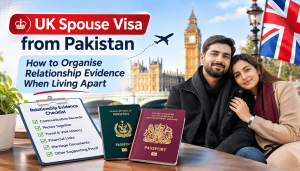
They can contribute to the picture of ongoing contact, but do not assume they establish every relationship requirement. Organise them alongside the marriage evidence, explanation of separation and other relevant records available in your case.
 Syed Adeel
Preparing a UK spouse visa from Pakistan can feel difficult when your husband or wife lives in the UK. You may speak every day but have few shared bills, no joint tenancy and only a short period together after your wedding.
Living apart does not automatically prevent a successful application. However, your evidence needs to explain the relationship as it exists: how it began, why you currently live in different countries, how you remain involved in each other’s lives and what you plan to do next.
A useful starting point is a dated relationship timeline supported by relevant records. This guide explains how to build that file without burying the important facts beneath hundreds of repetitive screenshots.
For a spouse application under Appendix FM, the relationship requirements include having met in person, being in a genuine and continuing relationship, having a valid marriage and intending to live together permanently in the UK. Previous relationships must have permanently ended, subject to the applicable rules.
A marriage certificate establishes an important part of your case. The wider evidence helps explain your life as a couple, including the period since the marriage.
This article focuses on organising relationship evidence. Your application must also address the other requirements that apply, including your partner’s qualifying status, finances, accommodation, English language and suitability.
A family visa as a spouse is different from permission as the dependant of someone on a work or study visa. Check your partner’s immigration status before using a checklist. Requirements for one route should not be copied into another application simply because both involve a married couple.
Also distinguish a first application from Pakistan from an extension after living in the UK. Your evidence should reflect your actual stage and circumstances.
Before scanning documents, sit down together and list the main events. Include how you were introduced, your first meeting in person, the marriage, visits and the periods spent apart.
Use exact dates where records confirm them. If you genuinely remember only the month, identify it as approximate instead of inventing a precise day. Keep introductions, engagement, nikah and later celebrations separate when they happened on different dates.
| Period | Event to explain | Possible supporting record |
|---|---|---|
| March 2026 | First meeting in person in Pakistan | Dated photograph and relevant travel record |
| December 2026 | Marriage ceremony | Marriage certificate and related records |
| January 2027 | UK-based spouse returned to work | Travel record and relevant employment evidence |
| February to August 2027 | Couple remained in contact while apart | Selected communication records |
| September 2027 | Further visit to Pakistan | Travel evidence and photographs together |
| At the time of application | Ongoing relationship and plans to reunite | Recent records and a clear explanation |
Keep the timeline short enough to scan. Its purpose is to direct the reader to evidence, not to repeat every conversation or family occasion.
Once complete, compare it with both partners’ passports, marriage documents and application answers. Resolve differences before uploading the file.
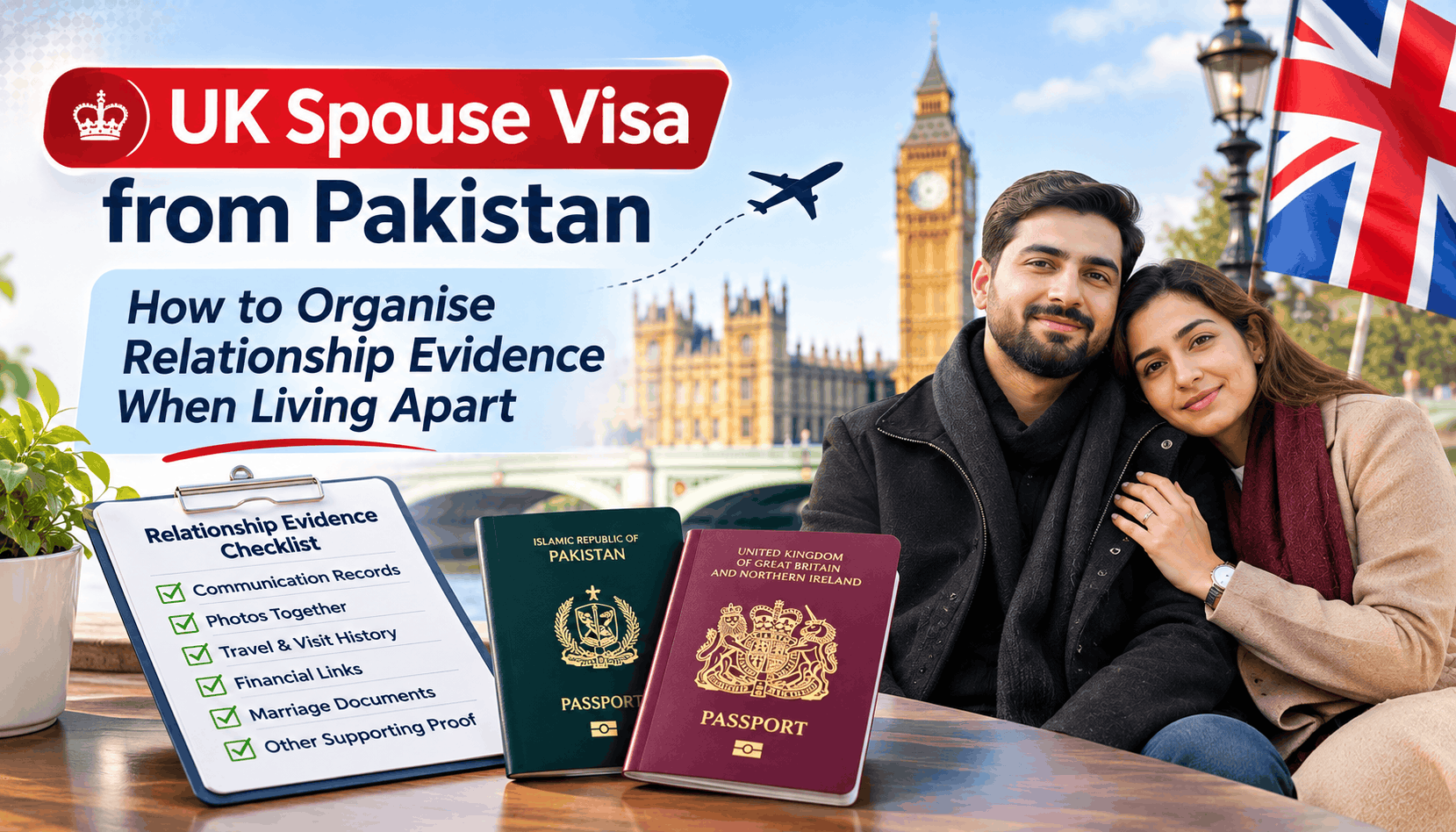
Create separate folders for the different parts of the relationship. This makes it easier to see which facts are supported and where an explanation is missing.
The categories below are a practical filing method. They are not a universal list of compulsory documents.
Start with the marriage certificate relied on for the application. For a marriage outside the UK, Appendix FM-SE provides for a valid certificate or reasonable equivalent issued by the appropriate authority.
For Pakistani records, check the names, dates and registration details across the nikah and marriage registration documents you hold. Ask which records are appropriate for your circumstances rather than assuming that a family registration document alone replaces proof of marriage.
Scan complete pages clearly, including relevant stamps and signatures. Keep each document with its translation so the two can be located together. Explain name variations with supporting records where available; do not silently change spellings on a scan.
For each visit, group the records around the same dates. A flight booking can explain planned travel, while available boarding passes, passport entries and photographs may help show the trip that took place.
Add brief photo captions describing the date, location and people shown. For example, “September 2025, family visit in Jhelum, applicant and spouse” is more useful than an unlabeled image.
Select photographs that add context across the relationship. Several almost identical wedding portraits usually explain less than a clear selection covering different relevant occasions. Avoid collages that make faces, dates or captions too small to read.
GOV.UK identifies regular communication as one way to demonstrate an ongoing commitment when a couple cannot live together. It also identifies financial support, care for shared children and time spent together as relevant examples.
For messages and call records, organise the material chronologically. Retain visible dates and enough identifying information to show whose conversation it is. If a contact is saved under a nickname, explain the connection rather than expecting the reader to recognise it.
Choose a proportionate selection across the relevant period, including recent contact. Avoid showing only the week before submission if the separation has lasted much longer. Follow any specific evidence request or upload instructions issued for your application.
Preserve original records. Do not edit message wording or reconstruct missing conversations. You do not need to make private exchanges more intimate for them to be useful; everyday arrangements can help explain a continuing shared life.
Where support genuinely occurs, organise transfer receipts and corresponding records by date. Make the sender, recipient and purpose understandable. If an account belongs to someone else, explain that arrangement and provide relevant supporting information rather than describing it as a direct payment between spouses.
Do not create unnecessary transfers solely to produce a paper trail. Some couples manage their expenses independently. Describe the real arrangement and use the evidence that exists.
Keep this material distinct from the documents used to meet the visa’s financial requirement. A transfer showing support between spouses does not, by itself, establish that the financial eligibility rules are met.
Where you have children together, identify relevant records of parentage and involvement in their lives. Include material that explains the family circumstances without adding unrelated sensitive information.
The caseworker guidance recognises that couples may be apart for reasons such as employment, study, cultural circumstances or caring responsibilities. The explanation should make clear why the separation exists and how the relationship continues despite it.
Write in ordinary language. State where each person lives, when the separation began and the actual reason for it. Then explain how you maintain contact, when you last met and your intention to live together in the UK.
Connect the explanation with the records already included. If employment is the reason, identify the relevant employment document. If a visit was cancelled, distinguish the cancellation from a completed trip.
The following is a fictional example for structure only:
“We married in Pakistan in December 2024. My spouse returned to the UK in January 2025 to resume employment, while I remained in Pakistan. We keep in contact through calls and messages, and my spouse visited me in September 2025. Our timeline identifies the records for that visit and our continuing contact. We intend to live together in the UK if my spouse visa is granted.”
Replace every detail with your own facts. If your circumstances are different, use a different explanation. A short, accurate account is more helpful than a polished statement that conflicts with the application.
Do not invent joint bills or describe a short visit as years of cohabitation. State accurately whether you have lived together, stayed together temporarily or maintained separate homes throughout the relationship.
The two-year relationship period relevant to the unmarried-partner definition is not a general requirement that a legally married couple must have lived together for two years before applying as spouses. Married applicants still need to satisfy the applicable relationship and other visa requirements.
If you married recently, show the history that actually exists. Explain how you met and how the relationship developed. Where an arranged introduction or separate cultural celebrations form part of that history, describe them clearly without assuming the reader knows the family context.
Appendix FM-SE requires specified documents outside English or Welsh to be accompanied by the original-language document and a full translation that can be independently verified. The translation must be dated and include confirmation of accuracy, the translator’s or authorised company official’s full name and signature, and contact details. Additional certification requirements apply to applications for permission to remain or settlement.
For Urdu documents and messages you intend to rely on, check the translation requirements before submission. An unexplained English paraphrase of a chat should not be presented as a verified translation.
If older records are unavailable, explain why. A replaced phone or lost account may leave a gap, but it should not lead to invented evidence. Look for genuine alternatives already available, such as travel records or other dated correspondence, and explain what each establishes.
Avoid treating a missing document as automatically fatal or assuming it will be ignored. The relevance of the gap depends on the circumstances and the evidence as a whole.
Use descriptive filenames and one consistent date format. A simple index can help you find the right document during preparation and help a reviewer understand the file.
| Suggested file name | Contents |
|---|---|
| Relationship-Timeline.pdf | Key dates and explanation of periods apart |
| Marriage-Documents.pdf | Relevant marriage records and translations |
| Visits-and-Time-Together.pdf | Chronological visit records and labelled photographs |
| Communication-Records.pdf | Selected dated contact records and relevant translations |
| Financial-Support.pdf | Genuine support records, where applicable |
| Living-Apart-Explanation.pdf | Reason for separation and plans to live together |
These names are suggestions, not official upload categories. Follow the actual portal’s categories, permitted formats and file-size limits. Check every uploaded file opens correctly and remains readable after compression.
Avoid uploading the same evidence repeatedly under different names. Keep an unchanged copy of your source documents and a separate folder containing the final submitted versions.
Review the relationship section together, then ask someone unfamiliar with the history to read the timeline. They should be able to understand the main events without guessing.
Do not measure the quality of the application by its page count. Each item should support a relevant fact or help explain the circumstances.
If you are preparing a UK spouse visa from Pakistan while living apart, begin with your marriage records, a short timeline and an explanation of the separation. These give a consultation a clear starting point.
AHS Consultants offers spouse and family visa services. Ask the team about support with your application and the organisation of your relationship documents, particularly if your records contain inconsistent dates, missing periods or previous-marriage issues.
Explore AHS spouse and family visa services
Request a consultation to discuss your circumstances and the documents you already hold.
This guide provides general information about organising evidence. Individual requirements depend on the visa route and circumstances, and UKVI makes the final decision.
They can contribute to the picture of ongoing contact, but do not assume they establish every relationship requirement. Organise them alongside the marriage evidence, explanation of separation and other relevant records available in your case.
The official guidance reviewed does not prescribe one universal number for every couple. Choose useful, readable evidence across the relevant period and comply with any specific request. A quote found online should not replace judgement about what your records show.
There is no general two-year marriage waiting period in the spouse relationship requirements. However, a recent marriage does not remove the need to demonstrate a genuine continuing relationship and meet the other applicable requirements.
A joint account can be relevant when one genuinely exists. Couples living in different countries may have other evidence. Explain your actual financial arrangements and avoid opening an account merely because a generic checklist mentions one.
No. Evidence must address the applicable requirements and accurately reflect your circumstances. UKVI decides the application; neither the number of pages nor a consultant’s involvement guarantees a visa.
Refer to the following official UK government sources for partner and spouse visa guidance, family visa evidence and relevant immigration rules.
WhatsApp us