
There is no universal six-month waiting period after an ordinary visitor refusal. Check the grounds of your decision and any applicable restrictions. Reapply when you can address the concerns, rather than using the calendar as the only test.
 Syed Adeel
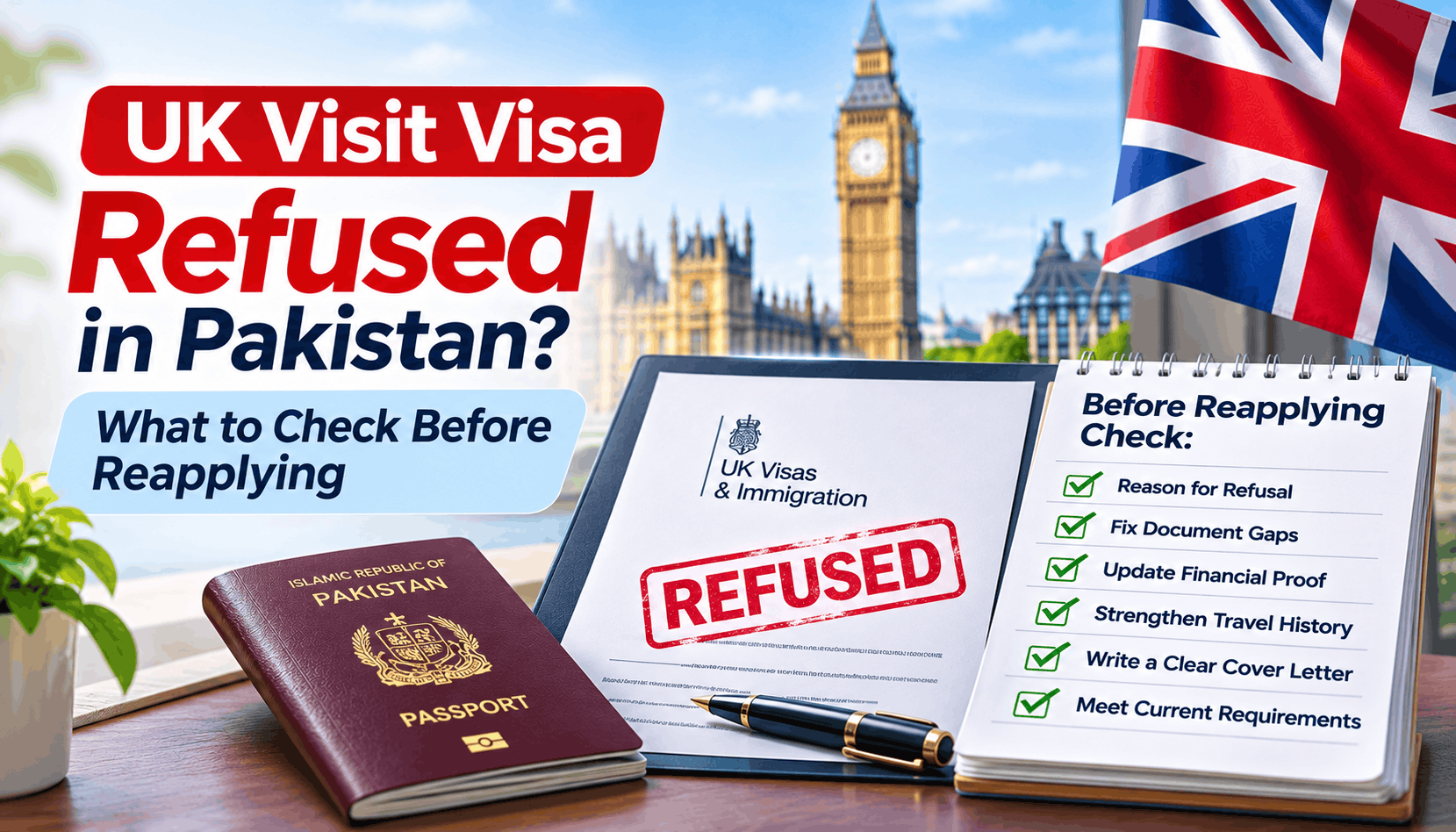
If your UK visit visa was refused in Pakistan, start with the decision letter and a copy of the application you submitted. Before paying for another application, work out exactly what concerned the decision-maker and whether your next submission can address it.
A fresh application may be appropriate when missing evidence, unclear explanations or changed circumstances can resolve the earlier concerns. Sending the same documents again with a longer cover letter may leave the underlying problem untouched.
This guide explains how to review a UK visitor visa refusal, organise the evidence and decide what needs attention before reapplying. It focuses on ordinary Standard Visitor applications made from Pakistan.
Do not rely on a summary such as “bank statement problem” or “weak ties.” Read the full refusal notice, including the rules cited, the explanation of the decision and any information about rights of challenge.
Gather your submitted application form, uploaded documents, invitation, financial records and submission confirmations. If someone prepared the application for you, obtain copies so you can check what UKVI actually received.
Separate each concern into its own note. A letter may question the source of funds, the affordability of the visit and your intention to return. Resolving one issue does not necessarily resolve the others.
Appendix V requires a genuine visitor to intend to leave after the visit, come for a permitted purpose and avoid using repeated visits to make the UK their main home. The applicant must also have enough qualifying funds for reasonable visit costs without prohibited work or access to public funds.
If your letter refers to V 4.2, identify the specific concern described beneath that rule. The paragraph reference alone is not a complete explanation of what needs to change.
A visitor refusal does not automatically mean you can never apply again. Official parliamentary guidance confirms that a fresh application can be made, with attention to the concerns raised in the refusal notice and the relevant visitor requirements.
For an ordinary visitor refusal, there is no general rule requiring every applicant to wait six months. However, that does not mean an immediate repeat application is sensible. The useful question is whether you can now present a properly supported application.
If the refusal mentions deception, false documents, immigration breaches or an applicable restriction, get advice on those findings before treating the case as a straightforward reapplication. Different grounds can have different consequences.
Routine visitor refusals generally do not carry a right of appeal. Standard Visitor applications are also not among the specified routes eligible for administrative review under Appendix Administrative Review.
Limited circumstances involving human rights may raise appeal issues, and judicial review may sometimes be relevant to an unlawful decision. These are specialist legal questions, not automatic alternatives available after every refusal.
Read the decision carefully and seek prompt advice from a suitably qualified immigration lawyer if you believe a legal challenge may be appropriate. A complaint, request for clarification or fresh application should not be assumed to preserve a legal deadline.
Create a working table that connects each concern with your explanation and supporting evidence. Keep this as your preparation tool; it is not an official UKVI form.
| Concern described in the refusal | Question to resolve | Evidence to consider where relevant |
|---|---|---|
| Income does not match account activity | Which credits are earnings, transfers or other receipts? | Income records and a transaction explanation |
| A large deposit is unexplained | Where did the money come from and is it available for the trip? | Records tracing the source and transfer |
| Visit costs appear disproportionate | What is the realistic cost and who will pay? | Revised budget based on genuine plans and funding evidence |
| Sponsor support is unclear | What support has actually been offered? | Specific sponsor statement and relevant financial records |
| Purpose or duration is unclear | Why this trip, for these dates? | Clear visit explanation and relevant event information |
| Return intentions are questioned | What circumstances support a temporary visit? | Relevant work, business, study or family records |
Do not treat every row as applicable to you. Use the actual wording of your refusal and identify which records answer it. If a concern remains unresolved, mark it clearly rather than filling the gap with unrelated paperwork.
UKVI’s visitor guidance expects the financial information on the form to correspond with the supporting records. There is no single fixed minimum bank balance for every visitor. The assessment considers the trip’s costs, available resources and ongoing commitments.
Review the figures you declared for earnings, savings, regular expenses and personal contribution to the trip. Use the same currency consistently, and distinguish monthly amounts from annual totals.
Make a list of the transactions the refusal questions. Record the date, amount, source and document that explains each one.
For example, a transfer between two accounts you own is not a second salary payment. A business receipt may not represent your personal disposable income. A relative’s contribution should be described as support rather than presented as earnings.
For freelancers, consider how invoices, platform payment records and bank credits connect. If payment dates or amounts differ because of fees or settlement delays, explain the actual reconciliation with available records. Avoid describing every credit as profit.
Adding money to an account after a refusal does not explain the previous deposits. If your circumstances have genuinely changed, describe the change and keep evidence of its source.
List the costs that apply to your trip: return travel, accommodation, food, transport and planned activities. Identify what you will pay and what another person will cover.
Check that the budget agrees with the planned duration. If you will stay with family, explain that arrangement. If the trip has become shorter or the funding has changed, give the genuine reason instead of silently replacing the old figures.
Do not forget the expenses that continue in Pakistan while you travel. Your working budget should help you understand what is actually available after those commitments.
Under the visitor rules, a third party can provide travel, maintenance, or accommodation support where the required relationship, immigration compliance, and ability and willingness to support conditions are met.
A sponsor’s invitation therefore needs to explain the arrangement clearly. However, sponsorship does not remove the need to establish that you qualify as a visitor.
Compare the sponsor’s statement with your form. If the form says you are self-funded but the invitation says the sponsor pays everything, resolve the discrepancy. If two people share the costs, identify each contribution.
The sponsor should review the final description before submission. Avoid using a generic letter that promises support the person has not agreed to provide.
Write a short description of why you want to travel, where you will stay and how long you intend to remain. A family visit, holiday and business meeting involve different practical arrangements; use details that reflect your real purpose.
If the original trip was for an event that has now passed, update the plan. Do not reuse an expired invitation and leave the reader to guess why the visit is still proposed.
When reviewing your circumstances in Pakistan, think about what relevant evidence actually shows. An employer’s letter might explain your role and approved leave. Business records might explain your continuing work. Study or family records may help explain other responsibilities.
These are examples, not a universal mandatory checklist. Do not invent employment, dependants or obligations to make your circumstances appear stronger. A brief statement explaining a document’s relevance is more useful than attaching it without context.
A cover letter can guide the reader through your new application. It should help locate the explanation and evidence, rather than ask the decision-maker to disregard the earlier refusal.
A practical structure is:
Keep the tone factual. Avoid promises of guaranteed return, exaggerated emotional claims or accusations that do not help explain the evidence.
The following is a fictional organisational example, not wording to copy unless it matches your facts:
“The refusal questioned a PKR 300,000 credit in my account. This was a transfer from my own savings account, rather than employment income. I have included statements for both accounts showing the corresponding debit and credit. My declared salary is explained separately by the employment records and salary credits.”
This explanation makes a specific claim and points to records that can be checked. It does not suggest that one explanation is enough to resolve every concern in the application.
Answer the new form’s questions about previous refusals and immigration history accurately. Check the relevant dates and details against your records, including refusals from other countries where the question asks for them.
If the old form contained an error, identify it and explain the correct position. Do not quietly substitute a different income, job description or family circumstance and assume the discrepancy will go unnoticed.
If an agent entered the information, you still need to understand what was submitted and review the new application yourself. Keep a complete copy of the final answers and documents.
Part Suitability contains separate grounds concerning deception, false representations and failures to disclose relevant facts. These issues can affect future applications and should not be treated as ordinary missing-document problems.
If the refusal raises such a finding, obtain advice on the exact wording and supporting records before submitting another application. A disagreement about a document should be addressed through genuine verification, not alteration or replacement with a fabricated record.
Every document should be readable, complete and relevant to the explanation it supports. Check names, account details, dates and page order. Use clear filenames so the important evidence is easy to locate.
Documents outside English or Welsh need a full independently verifiable translation. UKVI’s supporting-document guidance specifies an accuracy confirmation, translation date, translator’s full name and signature, and contact details.
The same guidance identifies documents that are generally not useful, including hotel and flight bookings for ordinary visits. Do not purchase non-refundable travel simply to make a reapplication look stronger. Follow any specific request UKVI makes in your case.
You should be able to explain what is different about the new submission and why it addresses the refusal.
If several points remain unclear, finish that review before rushing to pay. Waiting alone does not resolve a refusal, but time spent obtaining reliable evidence may make a new application more coherent.
If your UK visit visa was refused in Pakistan, bring the refusal notice, previous form and submitted evidence to your consultation. Having those records together makes it easier to discuss the concerns and identify what needs clarification.
AHS Consultants offers tourist and visit visa services. Ask the team about support with reviewing your application documents and preparing a fresh submission suited to your circumstances.
Explore AHS tourist and visit visa services
Request a consultation before paying for another application. Where a legal challenge is being considered, confirm that the professional handling it is appropriately qualified for that work.
There is no universal six-month waiting period after an ordinary visitor refusal. Check the grounds of your decision and any applicable restrictions. Reapply when you can address the concerns, rather than using the calendar as the only test.
Not necessarily. A larger balance does not explain where money came from or resolve separate concerns about the visit. Review the source of funds, declared figures and other reasons given in the letter.
Changing sponsors is not automatically necessary. Check whether the previous concerns involved the sponsor, your circumstances or inconsistencies between the documents. Any support you rely on must be genuine and satisfy the relevant conditions.
No. A fresh application can be considered, but you still need to meet the visitor requirements. Address the previous decision and any material changes honestly; no outcome can be guaranteed.
Identify the exact document, the relevant passage and any record showing it was submitted. Seek advice about whether a fresh application or a possible challenge is appropriate. Do not assume that an ordinary visitor refusal carries an administrative review right.
Refer to the following UK government and parliamentary sources for visitor visa rules, supporting documents, refusals and reapplications.
WhatsApp us